
Device Identification
Device: Wave Pro Shutter
- AU Part number / Ordering Code: QPSH-0A1P10AU
- Z-Wave Product type ID: 0x0003
- Z-Wave Product ID: 0x0084
- Z-Wave Manufacturer: Shelly Europe Ltd.
- Z-Wave Manufacturer ID: 0x0460
Terminology
- Device – In this document, the term “Device” refers to the Shelly Qubino device that is the subject of this guide.
- Gateway (GW) – A Z-Wave™ gateway, also referred to as a Z-Wave™ controller, Z-Wave™ main controller, Z-Wave™ primary controller, or Z-Wave™ hub, etc., serves as a central hub for a Z-Wave™ smart home network. The term “gateway” is used in this document.
- S button – The Z-Wave™ Service button, located on Z-Wave™ devices, is used for various functions such as adding (inclusion), removing (exclusion), and resetting the device to its factory default settings. The term “S button” is used in this document.
- Adding/Inclusion – The process of adding a Z-Wave device to a Z-Wave network (i.e., the gateway). Words like included, added, etc., are used in this context.
- Removing/Exclusion – The process of removing a Z-Wave device from a Z-Wave network (i.e., the gateway). Words like excluded, removed, etc., are used in this context.
Short Description
User does not have permission to view the page 'DEV:About the Device'.
Manual Operation for Shutter
Manual Operation with Momentary Switch
Parameter No. 71 set to 0 and Parameter No. 1 set to 0.
- Pressing the push-button connected to SW1 (up) for less than 0.5 second (short press) initiates upward movement.
- Pressing the push-button connected to SW2 (down) for less than 0.5 second (short press) initiates downward movement.
- If the shutter is moving, any press (on any push-button) will stop the movement.
- Pressing the push-button connected to SW1 (up) for more than 0.5 second (long press) initiates upward movement until the button is released.
- Pressing the push-button connected to SW2 (down) for more than 0.5 second (long press) initiates downward movement until the button is released.
| Action on Push-Button | Blind is Not Moving | Blind is Moving Up | Blind is Moving Down | Tilting Slats Ongoing |
|---|---|---|---|---|
| Short press (<0.5s) UP | Starts moving up | Stops moving | Stops moving | No action |
| Short press (<0.5s) DOWN | Starts moving down | Stops moving | Stops moving | No action |
| Long press (>0.5s) UP | Starts moving up; tilts slats (venetian) | Moving | Moving | Tilts slats → moves up |
| Long press (>0.5s) DOWN | Starts moving down; tilts slats (venetian) | Moving | Moving | Tilts slats → moves down |
| Release after long press | No action | Stops moving | Stops moving | Stops tilting |
Manual Operation with Toggle Switch
Parameter No. 71 set to 0 and Parameter No. 1 set to 1.
- Pressing the toggle switch connected to SW1 (up) initiates upward movement until the switch is released.
- Pressing the toggle switch connected to SW2 (down) initiates downward movement until the switch is released.
Manual Operation for Venetian Blinds with Momentary Switch
Parameter No. 71 set to 1 and Parameter No. 1 set to 0.
General Rules:
- Short press (<0.5 seconds) → initiates blind movement.
- Long press (>0.5 seconds) → initiates slats rotation.
Pressing SW1 (up) for <0.5s → starts moving up.
Pressing SW2 (down) for <0.5s → starts moving down.
If the shutter is moving, any press stops movement.
Pressing SW1 (up) for >0.5s → initiates slats rotation (0% to 100%) until release or end position. Rotation time defined in Parameter No. 72.
Pressing SW2 (down) for >0.5s → initiates slats rotation (100% to 0%) until release or end position.
| Action on Push Button | Blind is Not Moving | Blind is Moving Up | Blind is Moving Down | Tilting Slats Ongoing |
|---|---|---|---|---|
| Short press (<0.5s) UP | Starts moving up | Stops moving | Stops moving | Stops tilting |
| Short press (<0.5s) DOWN | Starts moving down | Stops moving | Stops moving | Stops tilting |
| Long press (>0.5s) UP | Starts tilting slats | No action | No action | Tilts slats to end |
| Long press (>0.5s) DOWN | Starts tilting slats | No action | No action | Tilts slats to end |
| Release after long press | No action | Stops moving | Stops moving | Stops tilting |
Manual Operation for Venetian Blinds with Toggle Switch
Parameter No. 71 set to 1 and Parameter No. 1 set to 1.
- Pressing a toggle switch connected to SW1 (up) initiates upward movement until released.
- Pressing a toggle switch connected to SW2 (down) initiates downward movement until released.
- When slats are at 100%, quick press of UP → moves blind up.
- When slats are at 0%, quick press of DOWN → moves blind down.
Slats Positioning
To achieve maximum precision when stopping via push-button, gateway, or remote control:
- When setting a new slats position while the blind is stopped, the slats first move to 100%, then back to the target position.
- When moving DOWN and reaching the limit switch (or being stopped), slats rotate to 100% then return to the previous position.
- When moving UP and stopped, slats rotate back to the previous position.
Main Applications
- Residential
- MDU (Multi Dwelling Units – apartments, condominiums, hotels, etc.)
- Light commercial (small office buildings, small retail/restaurant/gas station, etc.)
- Government/municipal
- University/college
- Farming
Integrations
Shelly Qubino Wave devices are developed using Z-Wave, the world’s leading technology for smart homes. This means they work with all certified gateways supporting the Z-Wave communication protocol.
We regularly test compatibility with different Z-Wave gateways to ensure full functionality.
Simplified Internal Schematics
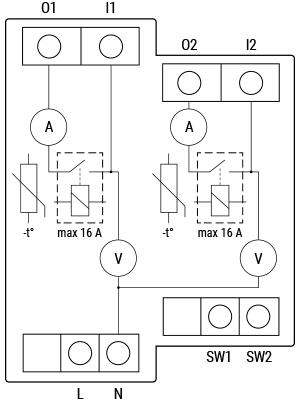
Device Electrical Interfaces
Inputs
- 2 switch/button inputs on screw terminals
- 2 power supply inputs on screw terminals: N and L
Outputs
- 2 relay outputs with power measurement on screw terminals
Connectivity
Z-Wave – Unsecure, S0 Security, S2 Unauthenticated Security, S2 Authenticated Security
Safety Features
- Over-load detection
- Overheat detection
Supported Load Types
User does not have permission to view the page 'DEV:Supported load types'.
User Interface
S Button and Operating Modes
- Normal mode
- Setting in progress mode
- Setting mode (with S button)
- Required to perform actions like inclusion, exclusion, factory reset.
- Limited-time mode; automatically returns to Normal mode after completion.
- Entering Setting Mode:
- Quickly press and hold the S button until LED turns solid blue.
- An additional quick press changes menu (infinite loop).
- Menu LED status has a 10-second timeout before returning to Normal mode.
S Button Functions
- Manually add the device to a Z-Wave network
- Manually remove the device from a Z-Wave network
- Factory reset the device
Functionality
Automatic calibration is the process during which the device learns the positions of the limit switches.
Note! For correct positioning, the device must perform a calibration procedure!
The motor must be equipped with electronic or mechanical limit switches, and the limits must be correctly set before calibration.
Shutter Positioning Calibration (Shutter Mode)
Parameter No. 71 set to 0
Calibration with Gateway
- Add the device to the Z-Wave network per inclusion instructions.
- Set Parameter No. 78 (forced Shutter calibration) to
1. - The device performs a full cycle: up → down → up → down to 50%.
- Check Parameter No. 78 — should be
2if successful. - Ensure yellow LED is not blinking.
Note: If value is
3or4, verify the device completes the full cycle (up, down, up, down to 50%), limit switches are correctly set, and wiring follows the user guide.
Calibration with Push-Button (SW1)
- Move blind to top (upper) position.
- Press SW1 four times within 3 seconds.
- Device starts calibration and completes 4 cycles: up → down → up → down to 50%.
- No time limit.
Calibration with S Button
- Enter Setting mode: press S button briefly (<0.5s).
- Hold S button until yellow LED appears (calibration selected).
- Press S button for >2 seconds to start calibration.
- Confirm yellow LED is not blinking.
Note: If yellow LED still blinks, verify full cycle execution, correct limit switches, and proper wiring.
Slats Tilting Position Calibration (Venetian Mode)
Parameter No. 71 set to 1
When enabling "venetian blind" mode, slats positioning calibration is required.
- Default rotation time: 1.5 seconds (adjustable via Parameter No. 72).
- If too slow: increase time.
- If too fast: decrease time.
Steps:
- Add and calibrate the device as described in Shutter Positioning Calibration.
- Set Parameter No. 71 to
1("Venetian blinds"). - Adjust Parameter No. 72 until slat rotation is correct.
- Repeat until desired behavior is achieved.
Note: Correct turning time ensures slats don’t cause blind movement during rotation.
LED Signalisation
General Rules
- Press S button once to switch between Normal and Setting modes.
- Solid LED = Setting mode (except plugs). Auto-returns to Normal mode after 10 seconds.
- LED turns off after 30 minutes (unless woken by S button press or power cycle).
Normal Mode LED Status
| State | LED Behavior |
|---|---|
| Removed/Excluded / Not Calibrated | Blinking blue for 10 min after power-up or S button press |
| Removed/Excluded / Calibrated | Blinking blue and yellow for 30 min after power-up or S button press |
| Added/Included / Not Calibrated | Blinking green for 10 min after power-up or S button press |
| Added/Included / Calibrated | Blinking green and yellow for 30 min after power-up or S button press |
Settings in Progress
| Event | LED Behavior |
|---|---|
| Factory Reset & Reboot | Solid green (~1 sec), then blue + red blinking (0.1s On/Off) for ~2 sec |
| Adding / Removing | Blinking blue in Mode 2 |
| Shutter Calibration | Blinking yellow in Mode 2 |
Settings Mode with S Button
| Menu Selected | LED Behavior |
|---|---|
| Adding/Removing | Solid blue (max 10 sec) |
| During Process | Blinking blue in Mode 3 |
| Factory Reset | Solid red (max 10 sec) |
| During Process | Blinking red in Mode 3 |
| Calibration | Solid yellow (max 10 sec) |
| During Process | Blinking yellow in Mode 3 |
Alarm Mode
| Alarm Condition | LED Behavior |
|---|---|
| Over-current detected | Blinking red (1x: 0.2s On/Off, 2s Off) |
| Overheat detected | Blinking red (2x: 0.2s On/Off, 2s Off) |
| Power Supply Fault | Blinking red (3x: 0.2s On/Off, 2s Off) |
LED Blinking Modes
| Mode | Blink Pattern |
|---|---|
| Mode 1 | 0.5s On / 2s Off |
| Mode 2 | 0.5s On / 0.5s Off |
| Mode 3 | 0.1s On / 0.1s Off |
| Mode 4 | (1–6x: 0.2s On/Off) + 2s Off |
| Mode 5 | 0.2s On blue / 0.2s On red |
Specifications
User does not have permission to view the page 'DEV:Technical Specifications'.
Basic Wiring Diagram
User does not have permission to view the page 'DEV:Wiring diagrams'.
Legend
Unable to render {include} – The included page could not be found.
About Z-Wave
Adding the Device to a Z-Wave® Network (Inclusion)
Note: The blind will move 2s up/2s down if successfully added/removed.
SmartStart Inclusion
- Scan the Z-Wave QR code on the device with a gateway supporting SmartStart.
- Add the Device Specific Key (DSK) to the provisioning list.
- Connect the device to power.
- If the blue LED blinks slowly, the device is not yet added.
- Automatic inclusion occurs within seconds.
- Blue LED blinks faster during inclusion.
- Green LED blinks slowly upon success.
Inclusion with S Button
- Connect device to power.
- Check if blue LED blinks slowly → not added.
- Enable add/remove mode on gateway.
- Press and hold S button until LED turns solid blue.
- Release, then press and hold (>2s) until blue LED blinks slowly → triggers Learn mode.
- Blue LED blinks faster during inclusion.
- Green LED blinks slowly if successful.
Note: Setting mode timeouts after 10 seconds.
Inclusion with Switch/Push-Button
- Connect device to power.
- Check if blue LED blinks slowly.
- Enable add/remove mode on gateway.
- Toggle switch/push-button 3 times within 3 seconds → enters Learn mode.
- Blue LED blinks faster during inclusion.
- Green LED blinks slowly if successful.
Learn mode – state allowing device to receive network info from gateway.
Removing the Device from a Z-Wave® Network (Exclusion)
Note: Custom parameters remain unchanged.
Removal with S Button
- Connect device to power.
- Check if green LED blinks slowly → device is added.
- Enable add/remove mode on gateway.
- Press and hold S button until LED turns solid blue.
- Release, then press and hold (>2s) until blue LED blinks slowly → triggers Learn mode.
- Blue LED blinks faster during removal.
- Blue LED blinks slower if successful.
Removal with Switch/Push-Button
- Connect device to power.
- Check if green LED blinks slowly.
- Enable add/remove mode on gateway.
- Toggle switch 3 times within 3 seconds → enters Learn mode.
- Blue LED blinks faster during removal.
- Blue LED blinks slower if successful.
Factory Reset
General
After reset, all custom settings revert to defaults. HOME ID and NODE ID are deleted. Use only if gateway is missing/inoperable.
With S Button
- Press and hold S button until LED turns solid blue.
- Press S button repeatedly until LED turns solid red.
- Hold S button (>2s) until red LED blinks faster → starts reset.
- LED turns solid green (~1s), then blue + red blink rapidly (~2s).
- Blue LED blinks slowly if successful.
With Switch/Push-Button
Only possible within first minute after power-up.
- Connect device to power.
- Toggle switch 5 times within 3 seconds.
- LED turns solid green (~1s), then blue + red blink rapidly (~2s).
- Blue LED blinks slowly if successful.
Z-Wave Security and Device Specific Key (DSK)
The device supports Security 2 (S2) using Strong AES 128 encryption — making Z-Wave the most secure IoT platform.
- Supports S2 Authenticated, Unauthenticated, and Unsecure inclusion.
- For S2 inclusion, the PIN Code (first 5 digits) from the DSK label is required.
- DSK label is printed on the side of the device and inside packaging.
- Do not remove the label.
- DSK is also represented as a QR code.
Note: The PIN Code must be kept safe. Use the backup in packaging.
Z-Wave Parameters
Unable to render {include} – The included page could not be found.
Z-Wave Command Class
Unable to render {include} – The included page could not be found.
Z-Wave Notifications Command Class
Unable to render {include} – The included page could not be found.
Z-Wave Associations
Unable to render {include} – The included page could not be found.
Z-Wave Important Disclaimer
Z-Wave wireless communication may not always be 100% reliable. Do not rely solely on this device for life-or-value-critical applications. If the device isn’t recognized or appears incorrectly, manually change the device type and ensure your gateway supports Z-Wave Plus™ multi-channel devices.
Troubleshooting
For troubleshooting, visit our support portal: https://support.shelly.cloud/
Compatibility with Gateways
| Gateway | Up | Down | SW Up | SW Down | W | kWh | Slats | SW Slats | Notes |
|---|---|---|---|---|---|---|---|---|---|
| Home Assistant | ✅ | ✅ | ✅ | ✅ | ✅ | ✅ | ✅ | ✅ | |
| Fibaro HC 3 / Z-Wave engine 3 | ✅ | ✅ | ✅ | ✅ | ❌ | ❌ | ✅ | ✅ | |
| Homey | ✅ | ✅ | ✅ | ✅ | ✅ | ✅ | ✅ | ✅ | |
| Homee Cube Gen 7 | ✅ | ✅ | ✅ | ✅ | ✅ | ✅ | ⚪ | ⚪ | *1 |
| Homee Cube Gen 5 | ✅ | ✅ | ⚪ | ⚪ | ⚪ | ⚪ | ⚪ | ⚪ | *1, *2, *3 |
| Smart Things | TBD | TBD | TBD | TBD | TBD | TBD | TBD | TBD | With Shelly Wave edge driver |
| Vera Ezlo | ✅ | ✅ | ✅ | ✅ | ✅ | ✅ | ✅ | ✅ | |
| Cozify | ✅ | ✅ | ✅ | ✅ | ✅ | ✅ | ✅ | ✅ |
Notes:
- *1: Slats cannot be controlled via UI; position not visualized.
- *2: Reports sent only via buttons; slider sends to location but doesn’t refresh state.
- *3: State refreshed only after stop button pressed.
- *4: Device sent to position but position not reported.
Legend
| Symbol | Meaning |
|---|---|
| ✅ | Working / Possible |
| ⚪ | Not Working / Not Possible |
| P | Partially |
| N/T | Not Tested |
| TBD | To be done |
Function Definitions
| Function | Meaning / Tested |
|---|---|
| On/Off | Responds to app UI On/Off command |
| SW On/Off | Reports On/Off changes via SW input |
| Dimming | Responds to app UI dimming command |
| SW Dimming | Reports dimming state change via SW |
| Watts | Watts reported unsolicited |
| kWh | kWh reported unsolicited |
| Up/Down | Responds to app UI Up/Down command |
| SW Up/Down | Reports Up/Down changes via SW |
| Slats | Slats respond to app UI command |
| SW Slats | Slats report changes via SW |
| D control | Detached mode: reports scene commands (single/double press, etc.) |
| D Binary | Detached mode: reports binary On/Off via SW |
| Sensor # | Sensor report visible in gateway; type noted |
Gateway Guides
Useful guides available in the Shelly Knowledge Base.
Compliance
- Wave Pro Shutter multilingual EU Declaration of Conformity (2025-07-23)
- Wave Pro Shutter UK PSTI ACT Statement of Compliance